Eastern subterranean termites (Reticulitermes flavipes) cause persistent structural damage throughout Warren County due to South Central Kentucky's extensive limestone karst topography. Subterranean termites require…
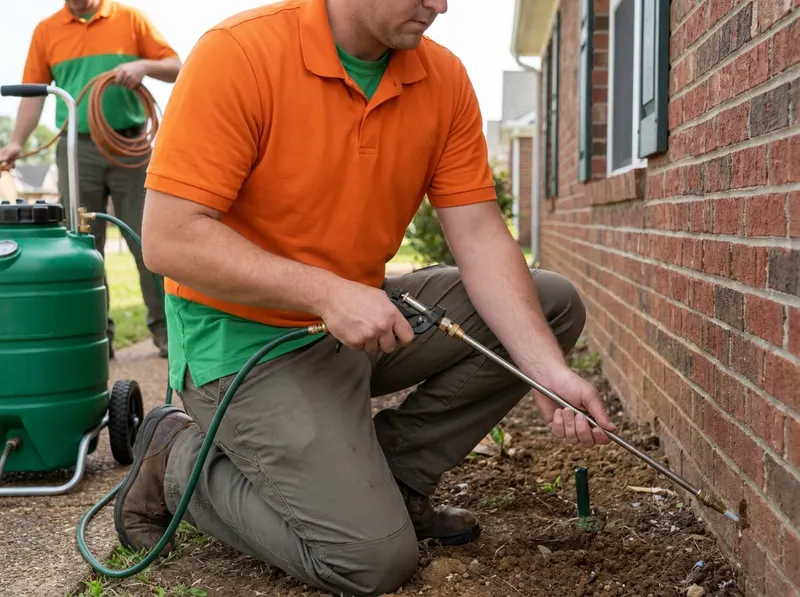
Eastern subterranean termites (Reticulitermes flavipes) cause persistent structural damage throughout Warren County due to South Central Kentucky's extensive limestone karst topography. Subterranean termites require continuous contact with soil moisture to survive, utilizing underground fissures, sinkhole networks, and moist crawl spaces near Lost River Cave and Jennings Creek to access residential subfloors. In neighborhoods such as Briarwood, Indian Hills, and Old Towne, older homes built on crawl spaces or unsealed stem walls allow worker termites to construct mud tubes upward over foundation footers. Modern slab-on-grade developments in Covington Grove, Fieldstone Farms, and Hartland experience termite entry through expansion joints, bath traps, and plumbing penetrations hidden beneath utility flooring.
Effective defense requires an Integrated Pest Management protocol rather than retail surface repellents, which cause subterranean colonies to split and enter alternative structural voids. Liquid termiticide treatments involve digging a 6-inch by 6-inch trench directly against the exterior foundation perimeter, applying 4 gallons of finished non-repellent termiticide per 10 linear feet. Where concrete patios, brick porches, or carports abut living areas in Downtown Bowling Green or Fairview, technicians drill 0.5-inch holes spaced 12 inches apart through the slab to saturate the underlying soil before sealing each hole with mortar. For homes adjacent to sensitive karst drainage features or shallow groundwater tables, baiting systems installed at 10-foot intervals provide colony elimination by dispersing insect growth regulators without heavy liquid soil drenching.
Decision fit depends entirely on foundation architecture and nearby waterways. Liquid soil treatments provide immediate chemical continuous barriers lasting 5 to 8 years, serving as the standard option for detached houses with accessible soil perimeters; the trade-off is the requirement of minor concrete drilling along attached garage slabs. Baiting stations present zero risk of chemical leaching into subterranean karst caverns, functioning through worker feeding cycles over 60 to 90 days; the trade-off is the requirement of quarterly cartridge monitoring rather than a single completed installation. Spot treatments satisfy localized termite swarm emergencies or real estate closing requirements starting at the $200 service minimum, whereas entire perimeter defenses address multi-point subterranean colonies. Inspections can be scheduled directly at (270) 721-5916.
Every job gets a firm, written price after a free on-site visit.
Tell us about your subterranean termite treatment job in Bowling Green and we'll send a clear, written quote, usually the same day.
 Zorvilo Pest Control