Warren County’s subterranean topography creates persistent vector challenges throughout the warm months. Bowling Green sits over an extensive limestone karst network, anchored by formations like Lost River Cave, where…
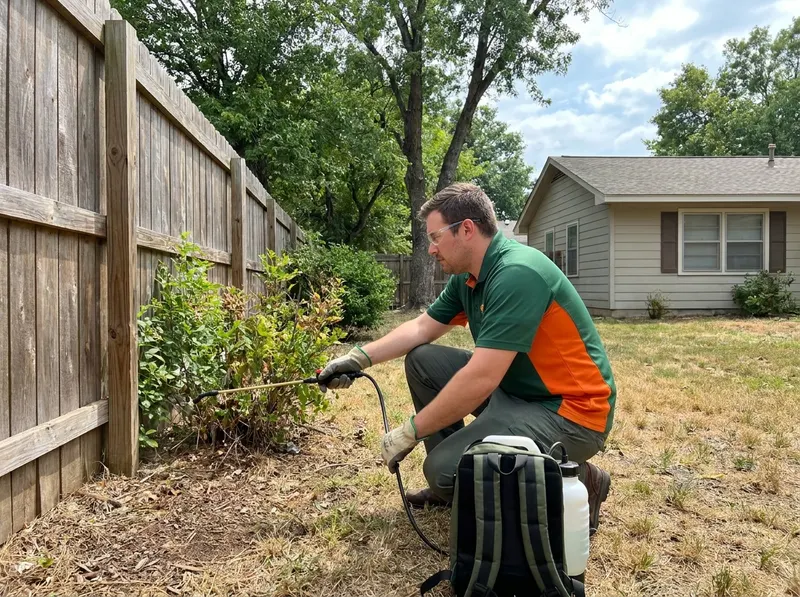
Warren County’s subterranean topography creates persistent vector challenges throughout the warm months. Bowling Green sits over an extensive limestone karst network, anchored by formations like Lost River Cave, where sinkholes, subterranean fissures, and slow-draining depressions hold stagnant water out of direct sunlight. These microclimates accelerate egg development for Aedes albopictus and Culex mosquitoes, which migrate directly into residential properties in neighborhoods like Briarwood, Covington Grove, and Indian Hills. Standard retail foggers emit an ultra-fine thermal mist that drifts away within 15 minutes, failing to bond with biological harborage sites. Professional perimeter suppression relies on backpack mist blowers delivering heavy, microencapsulated droplets calibrated to 50 to 100 microns. This specification ensures droplets adhere to the undersides of broadleaf plants, boxwood hedges, and perimeter tree lines where adult mosquitoes rest during peak midday heat.
Residential yards adjacent to greenways, such as properties bordering Basil Griffin Park in Hartland or mature shaded lots in Old Towne and Fairview, require botanical barriers that withstand rainfall. Microencapsulated synthetic pyrethroids bind to plant cuticles, providing 21 to 28 days of continuous residual lethality. When an adult insect lands on the treated leaf surface to shelter from wind or sun, the formulation disrupts its nervous system within minutes. Concurrently, natural standing water sources, including ornamental fountains near Downtown Bowling Green, catch basins, and low-lying perimeter ditches in Crossridge and Fieldstone Farms, are treated with Bacillus thuringiensis israelensis (BTI). BTI is a naturally occurring soil bacterium that targets mosquito larvae exclusively, leaving beneficial aquatic organisms, family pets, and native wildlife unharmed.
Selecting barrier suppression over whole-yard broadcast treatments avoids unnecessary chemical loads on open grass where mosquitoes do not rest. Turfgrass receives direct sunlight and wind, preventing mosquitoes from harboring there. Directing materials exclusively to perimeter vegetation zones 10 feet deep and 10 feet high cuts broad chemical exposure by roughly 70 percent while eliminating the primary harborage zones. The practical limitation involves heavy precipitation: rainfall exceeding 2 continuous inches immediately following an application can compromise the chemical bond before cure time completes, necessitating a perimeter touch-up once foliage dries.
Every job gets a firm, written price after a free on-site visit.
Tell us about your mosquito perimeter suppression job in Bowling Green and we'll send a clear, written quote, usually the same day.
 Zorvilo Pest Control