Residential properties across Warren County experience heavy stinging insect pressure beginning in late spring and peaking through September. In established neighborhoods like Indian Hills, Old Towne, and Briarwood,…
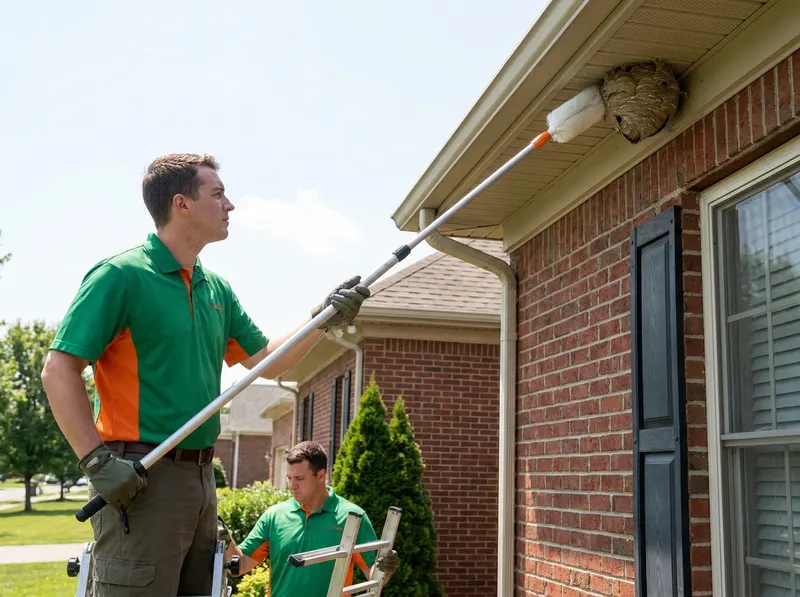
Residential properties across Warren County experience heavy stinging insect pressure beginning in late spring and peaking through September. In established neighborhoods like Indian Hills, Old Towne, and Briarwood, mature tree canopies and complex roof profiles provide prime harbourage for paper wasps and bald-faced hornets. Further south near Fieldstone Farms, Hartland, and Covington Grove, modern architectural soffits, covered porches, and vinyl overhangs routinely shelter concealed nests. Karst topography around landmarks like Lost River Cave and nearby greenways creates natural limestone crevices and soil hollows where subterranean yellowjacket colonies thrive. When yellowjackets establish colonies beneath turf or within exterior wall sheathing, generic retail contact sprays fail because they agitate the colony without penetrating the primary brood chamber.
Protective stinging insect management relies on targeted integrated pest management protocols rather than widespread chemical drenching. Ground nests require pressurized insecticidal dusts that penetrate subterranean soil galleries, deactivating workers, larvae, and reproductive queens directly without saturating the surrounding yard. Aerial nests suspended along two-story roof peaks in Crossridge or Fairview are treated with specialized telescoping application equipment using low-odor pyrethroid microencapsulations. The trade-off between exterior physical removal and structural wall void treatments involves containment: exterior open-air nests allow direct knockdown and immediate mechanical removal, whereas nests situated within exterior siding or soffit voids require internal desiccant dusting and a 24-hour settling period to ensure all returning foragers are neutralized before sealing entrance voids.
Every treatment is calibrated to protect family hygiene and household pets while eliminating re-infestation risks. Technician protocols involve three distinct phases: first, systematic thermal or visual identification of all entry holes and flight paths; second, localized application directly into the nest matrix to eliminate active stinging threats without airborne drift inside living spaces; and third, physical scraping, structural cleaning of pheromone footprint markers, and application of a repellent residual perimeter barrier. Property owners experiencing active swarms can contact (270) 721-5916 to establish secure boundaries.
Every job gets a firm, written price after a free on-site visit.
Tell us about your stinging insect and wasp removal job in Bowling Green and we'll send a clear, written quote, usually the same day.
 Zorvilo Pest Control