Surface spraying with retail pyrethroid aerosol produces an immediate localized kill, but it consistently triggers colony budding in species like odorous house ants, causing a single reproductive nest to fracture into…
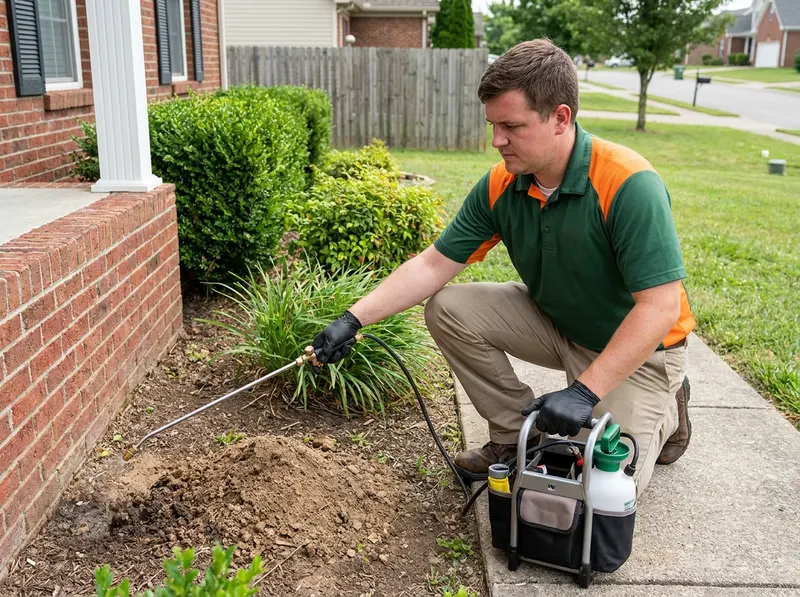
Surface spraying with retail pyrethroid aerosol produces an immediate localized kill, but it consistently triggers colony budding in species like odorous house ants, causing a single reproductive nest to fracture into 3 to 5 distinct satellite colonies throughout kitchen wall voids. Professional eradication relies instead on undetectable non-repellent liquid formulations and slow-acting macro-nutrient baits. Foraging worker ants ingest or walk through these active ingredients without alarm, transporting the undetectable chemistry back to the central subterranean or structural nest over a 48 to 72-hour window. The toxicant spreads through trophallaxis, the biological regurgitation and mutual food-sharing process among ants, delivering lethal doses directly to reproductive queens, brood larvae, and hidden workers that never venture outdoors.
Warren County's distinct subterranean topography heavily influences local ant biology. Bowling Green rests atop extensive porous limestone karst terrain, characterized by underground drainage networks and sinkholes near landmarks like Lost River Cave and Basil Griffin Park. This geological moisture profile forces carpenter ants and pavement ants upward into structural home perimeters during prolonged rainy springs and humid summer months. In older architectural framing throughout Downtown Bowling Green and Old Towne, persistent moisture wicking along sill plates provides an ideal environment for carpenter ants to carve structural galleries out of damp 2x4 framing. Across slab-on-grade foundations common in Briarwood, Indian Hills, and Covington Grove, pavement ants frequently push soil through expansion joints and plumbing penetrations beneath dishwashers and utility rooms.
Effective eradication requires matching chemistry to seasonal colony nutritional demands. In early spring, awakening colonies prioritize high-protein matrices to support new larval brood production, rendering standard sugar gel baits completely ineffective. By mid-summer, when colonies in neighborhoods like Hartland, Fieldstone Farms, and Crossridge face high reproductive maturity, workers shift their dietary intake toward liquid carbohydrates to sustain active adult workforces. Applying botanical or synthetic non-repellents along the exterior foundation perimeter creates a 3-foot vertical and 3-foot horizontal treated buffer zone. This perimeter stops outdoor satellite nests nesting in landscape mulch and railroad ties from bridging into the home envelope, safeguarding interior spaces without airborne residual odors or chemical vaporization.
Every job gets a firm, written price after a free on-site visit.
Tell us about your ant colony elimination job in Bowling Green and we'll send a clear, written quote, usually the same day.
 Zorvilo Pest Control