Zorvilo Pest ControlZorvilo Pest Control

Nuisance Wildlife Trapping and Exclusion Bowling Green

Residential wildlife encounters in Warren County frequently occur along karst topography and mature tree canopies. Neighborhoods like Indian Hills, Fairview, and Briarwood feature established oak and hickory covers…
Get My Free Estimate →(270) 721-5916
Nuisance Wildlife Trapping and Exclusion in Bowling Green, KY
Quick answer
  • Scope includes diagnostic attic inspections, humane live-trapping sets, animal removal, thermal insulation spot-cleanup, and permanent exterior structural sealing.
  • Trap checks and dispatch cycles occur within mandatory 24-hour intervals under Kentucky Department of Fish and Wildlife Resources regulations.
  • Base animal extraction starts at a $200 minimum, with complete multi-point architectural exclusion plans ranging between $650 and $1,800 depending on structural damage.
  • Species handled include gray squirrels, raccoons, striped skunks, Virginia opossums, bats, and groundhogs nested inside chimneys, attics, and subfloors.
  • Service coordination occurs directly through local field dispatch by calling (270) 721-5916 for an on-site property assessment.

Residential wildlife encounters in Warren County frequently occur along karst topography and mature tree canopies. Neighborhoods like Indian Hills, Fairview, and Briarwood feature established oak and hickory covers where eastern gray squirrels and raccoons access rooflines through gutter edges and overhanging branches. When limestone sinkholes and cave fissures beneath locations near Lost River Cave push small mammals toward residential developments like Fieldstone Farms and Hartland, animals exploit vinyl gable vents, uncapped brick chimneys, and crawlspace louver vents. The structural trade-off in animal mitigation centers on trapping versus complete architectural exclusion. Trapping alone removes the immediate animal occupying the attic floor, but leaving an unsealed gap means adjacent neighborhood populations reoccupy the scent-marked insulation within weeks. Mechanical trapping combined with heavy-gauge physical barriers requires a higher initial investment than retail deterrent sprays, yet it prevents continuous re-infestation and urine contamination in residential joists.

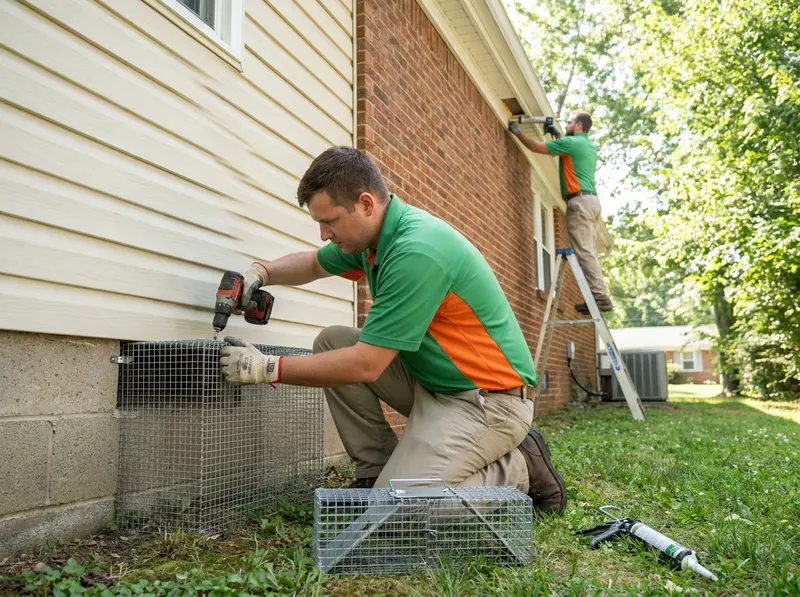
Structural exclusion stops access by modifying weak architectural elements. Technicians seal soffit intersections, fascias, and foundation gaps using 16-gauge 1/4-inch galvanized hardware cloth, which gnawing rodents cannot chew through. In historic Old Towne and Downtown Bowling Green brick structures, older mortar voids and foundation crawl vents require tight steel lath masonry anchors. In newer developments such as Covington Grove and Crossridge, animals target plastic attic ridge vents and unbolted crawlspace access well doors. When raccoons or squirrels pull away aluminum fascia, the restoration sequence requires three distinct steps: 1. Deploy species-specific humane box traps or one-way exclusion funnels directly along observed travel tracks. 2. Remove captured animals and inspect crawlspaces or attic insulation for nesting kits. 3. Fasten structural metal exclusion caps, apply broad-spectrum antimicrobial misting to neutralize biohazard droppings, and seal perimeter entry points.

Nuisance Wildlife Trapping and Exclusion cost in Bowling Green

Initial Inspection & Single Small Mammal Trap Setup$200 - $350
Raccoon or Skunk Trapping Sequence (3 to 5 Day Trapping Run)$350 - $600
Roofline Gable & Soffit Hardware-Cloth Exclusion (Per Section)$300 - $750
Comprehensive Structural Seal & Attic Decontamination (Whole Home)$850 - $2,200

Every job gets a firm, written price after a free on-site visit.

Common questions

How much does nuisance wildlife trapping cost in Bowling Green?
Wildlife trapping services in Bowling Green carry a base service minimum of $200, which covers site diagnosis and initial cage placement. Full projects that incorporate multi-point hardware cloth installation, attic bio-sanitation, and recurring trap resets range between $450 and $1,800 based on structural entry counts.
Does wildlife exclusion require chemical sprays inside living spaces?
Physical exclusion relies on mechanical structural repairs and galvanized steel cloth rather than airborne chemical sprays inside home living areas. The only compound applied is a targeted hospital-grade disinfectant misted directly over localized droppings in attics or crawlspaces to eliminate histoplasmosis spores and bacterial odor.
How often are animal traps inspected on Warren County properties?
Traps set on residential properties in Warren County undergo physical inspection at least once every 24 hours in adherence to Kentucky wildlife regulations. Timely checks reduce animal distress and verify that target pests are removed quickly without leaving carcasses in attics or crawlspaces.
What is the protocol for bats inside an attic in Bowling Green?
Bat remediation in Bowling Green employs passive one-way exclusion valves that let bats fly out at dusk while barring re-entry into the structure. Due to federal and state protective status, structural sealing occurs after the maternity season, ensuring young pups are not sealed inside the attic void.
Can technicians seal an entry hole the same day traps are installed?
Technicians do not seal the primary entry hole immediately while animals are actively feeding or foraging inside, as trapping an animal within the walls causes structural chewing and decomposition. Secondary gaps are sealed first, followed by installing a one-way exit door or live trap, with final permanent sealing completed once thermal scans confirm the space is clear.

Get started today

Tell us about your nuisance wildlife trapping and exclusion job in Bowling Green and we'll send a clear, written quote, usually the same day.

Get your free pest control services quote, Bowling Green

We only use your ZIP to check availability, no spam.